The walking meditation is a form of conscious breathing combined with soulful, calm movements. It can be practiced anywhere in nature – for example, during a forest walk or in another undisturbed location. We will show you how this mindful walking works.
Duration of a Walking Meditation
For walking meditation, allow at least half an hour, or preferably an hour; it’s better to plan more time, especially for the first time. If you have practiced walking meditation often, you will see that a duration of 15 minutes is also sufficient to fully relax and regulate your nervous system.

If you practice walking meditation during your Ayurveda morning routine or throughout the day, it’s like a mini-vacation for body and soul. It clears your mind, allowing you to start the second half of the day completely relaxed and with fresh energy. In this way, walking meditation can be practiced very well, for example, between work and household chores or after an important meeting.
Of course, you can also perform this meditation technique in the evening. It will help you unwind and let go of the day’s events, ensuring a restful night’s sleep.

“Even a few mindful steps can help calm the mind and create new presence. Walking meditation combines movement, breathing, and inner contemplation in a particularly beneficial way.”
Elisabeth Naschberger-Mauracher, European Ayurveda Expert & Managing Director of the European Ayurveda Resort Sonnhof in Tyrol
Preparing for Walking Meditation: The Right Place
You can actually do this meditation anywhere in nature. It is important that you are undisturbed and not distracted by noise or other people. Perhaps you know a beautiful forest path, or you can walk along a stream or lake. If you have a large garden, you are welcome to meditate there too. Of course, you can also practice in a room, but make sure you can move freely.
You can also walk barefoot, but it is important that you feel comfortable. Comfortable shoes are definitely recommended!
When you are ready to start walking meditation, you can first do a small grounding exercise:
Stand firmly on the ground with both feet, adopt a relaxed posture, and let your hands hang loosely by your sides. Your knees should be slightly bent and relaxed. Gently sway slightly to the left, to the right, forward, and backward until you find your stable center of gravity.
Then close your eyes and imagine breathing in through your head, the breath flowing through your body, and as you exhale, streaming through your feet into the ground. Do this exercise for a few minutes and feel yourself rooted to the earth.
How Walking Meditation Works: A Guide for Beginners
Feel the ground beneath your feet and take a deep breath. Concentrate entirely on your breathing and the sensation in your feet. Lower your head slightly so that you can perceive a small area around your feet with half-open eyes.
Then shift your body weight from your right foot to your left foot, so that almost all the weight rests on your left foot. Now slowly lift your right foot. Start with the heel, then the sole of the foot, and finally the toes.
Carefully place your foot back down, starting again with the heel. Make smooth, flowing movements. Then shift your weight to your right foot and repeat the process by slowly moving your left foot forward.
During the movement, notice every small change in your body. As you lift your foot, observe how your muscles tense; as you place it down, feel the temperature and unevenness of the ground on your feet; as you shift your weight, feel how your entire body works to maintain balance.
Breathe slowly and evenly, and engage your senses. Enjoy your surroundings during the meditation. What can you see, hear, or smell here? Listen to the sounds of nature and breathe the fresh air into your lungs.

Be aware of your posture and periodically check if your thoughts are still with your feet. If not, redirect your attention specifically to your feet and breath to prevent your mind from wandering.
You are welcome to vary the pace occasionally; just see what feels comfortable for you. It is advisable to walk at a moderate pace and enjoy the slowness. Be grateful that you can walk, and enjoy the tranquility that settles in during the walk.
Try to fully enjoy the present moment and let go of everything you don’t need right now. Feel like the happiest person in the world, rejoice in your ability to walk, and smile.
After a while, stop again. You can close your eyes and lift your head. Feel how your feet feel now, and observe your breathing. Finally, take another deep breath and then open your eyes.
Further Variations of Walking Meditation
Walking meditation is a form of meditation that has been practiced for centuries by various religions and Buddhist schools. Therefore, it exists in different forms and traditions.

Here are the 4 most important ones at a glance:
- Theravada Vipassana Walking Meditation
- Kinhin Walking Meditation in Zen Buddhism
- Walking Meditation according to Thich Nhat Hanh
- Forest Bathing as Mindful Walking
1. Theravada Vipassana Walking Meditation
Walking meditation is a central meditation technique, especially in Theravada Buddhism. Monks usually cover a distance of 10 to 15 meters and walk back and forth. You start at the beginning of the designated path and begin as described above. However, before you lift your foot, consciously say “lifting” to yourself internally. Then perceive the pushing movement as you take a step and say “lowering” as you place your foot down.
You repeat this conscious sequence until you reach the end of the path. Then you perform a mindful turn of your body, which you also mentally accompany. This technique more actively directs your consciousness to the movements and makes it easier for you to guide wandering thoughts back to the present moment.
2. Kinhin Walking Meditation in Zen Buddhism
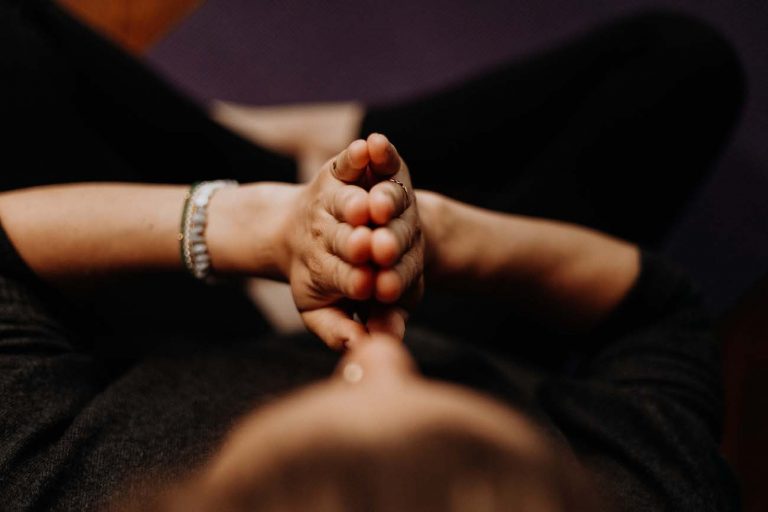
In Zen Buddhism, this meditation is also performed as Kinhin walking meditation. Here, the hands are held in shashu – the left hand is formed into a fist, and the right palm covers it so that the right thumb rests between the left thumb and index finger. The folded hands are held above the navel.
Now coordinate your breathing and steps so that with each breath (complete inhale and exhale), you take one step forward. Typically, the distance covered in Kinhin walking meditation is a circle or rectangle. Concentrate your mind on the connection between breath and movement.
3. Walking Meditation according to Thich Nhat Hanh
The Vietnamese monk Thich Nhat Hanh practiced a freer form of walking meditation, which he combined with affirmations. Walk completely relaxed and simply be aware that you are walking. Loosely synchronize your breathing with your steps, perceive the earth beneath you, and leave your thoughts behind. Enjoy every step and feel gratitude within you.
Mentally repeat the following affirmations:
- Inhale: “I have arrived.”, Exhale: “I am home.”
- Inhale: “In the here.”, Exhale: “In the now.”
- Inhale: “I am solid.”, Exhale: “I am free.”
4. Forest Bathing as Mindful Walking in Nature
Forest bathing is an increasingly popular method to reduce stress and calm the mind. The method comes from Japan and is mindful walking in the forest, where you engage all your senses and consciously remain in the present moment. However, it is not to be confused with a normal walk in the forest!

For this, walk mindfully and slowly with many conscious pauses to smell, hear, see, and feel the forest floor. Repeatedly do small mindfulness exercises, for example, perceive the scent of fresh resin, observe the sun’s rays in the treetops, or feel the bark of a tree.
Advanced Extension: Walking Meditation in Everyday Life
Once you master the meditation, you can easily access it even in busy places. Use waiting times to meditate. The next time you have to wait for something or someone, you can use the time to meditate without others noticing.
For example, you can walk back and forth at the train station, inhaling for three steps, holding your breath for three steps, exhaling for three steps, and holding your breath for three steps. This way, you can use every small waiting period to recharge with fresh energy.
Positive Effects of Walking Meditation on Body and Mind
Buddha summarized the benefits of walking meditation in five points:
- improved stamina and ability to walk longer distances
- increased psychological and physical resilience and fitness
- prevention of diseases and promotion of health
- promotion of digestion and the digestive fire Agni
- improved concentration, which lasts even after meditation
Walking meditation is particularly suitable for people who sit a lot in their daily lives or for meditation beginners who still find it difficult to sit still for long periods. People who experience pain while sitting due to spinal or knee conditions or injuries also benefit from mindful walking.
Overall, this meditation technique can improve your physical, mental, and spiritual health. It helps you arrive in the here and now, interrupt racing thoughts, and gently move your body at the same time.
Walking also increases oxygen intake and can help with digestive problems – the positive effects last for a while even after meditation. Just try it yourself and benefit from more energy in everyday life!

6 Popular Meditation Exercises for Beginners
In Ayurveda, meditation has long been a proven method for living a calmer and more conscious life. The beauty of it is: anyone can learn to meditate! Here we show you a few simple meditation exercises that you can try as a meditation beginner.