If there is one indispensable ingredient in Ayurvedic cuisine, it is undoubtedly Ghee! This clarified butter offers significant advantages over other fats and can be used not only for sautéing but also for various health purposes. But what exactly is Ghee? Learn all about its uses, whether this pure fat is healthy or unhealthy, and much more here.
What Exactly is Ghee?
Essentially, it refers to nothing other than clarified butter, butterfat, or anhydrous milk fat. This clarified butter has nearly 100 percent fat content, a rich yellow color, and a slightly firmer consistency. Its aroma is more intense than that of unclarified butter.
During its production, the water content completely evaporates, and animal protein and milk sugar separate. This makes it long-lasting even without refrigeration, which is why it is particularly popular in South Asia and the Middle East. Traditionally, it is produced in Pakistan and India.
In Ayurveda, it is credited with antioxidant, detoxifying, and anti-inflammatory properties. It can be used both externally and internally. It is already very popular, especially in ketogenic diets.
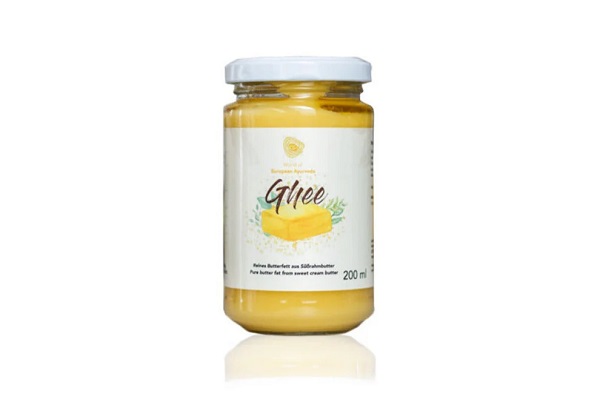
Discover our European Ayurveda® Ghee now
The “liquid gold” of Ayurvedic medicine. In Ayurveda, Ghee is considered food, a dietary supplement, and medicine all at once. Discover it now in our European Ayurveda® online shop!
Is Ghee Healthy or Unhealthy?
In fact, Ghee is the healthiest of all types of fat we can use in our daily lives. This is because the end product of the manufacturing process contains 70 percent saturated fatty acids.
Contrary to the long-held belief that saturated fatty acids are unhealthy, we now know the exact opposite is true. The short-chain fatty acids and conjugated linoleic acid (CLA) it contains are particularly easy to digest and provide the body with quick energy.
It is healthy because it contains vitamins D, E, and A. However, we must note that you would need to consume a considerable amount to meet your full daily requirement. The quality of the butter also plays a significant role.
However, excessive consumption—like all fatty acids—can contribute to fatty liver. (2) Clarified butter contains a lot of cholesterol (approx. 264 g per 100 g of Ghee) and should therefore only be enjoyed in moderation. Does this make Ghee unhealthy? No, in moderation, it can have many positive effects, but like all fats, it should simply be consumed sparingly.
Is Ghee Vegan?
Producing clarified butter without butter—even Ayurvedic cuisine reaches its limits there. According to traditional recipes, Ghee is therefore not vegan, as it is necessarily derived from animal fat.
However, vegan Ghee is now available in more and more health food stores. Alternatively, you can use high-quality coconut oil instead of butter—vegan Ayurvedic cuisine often uses such alternatives.
Benefits of Indian Cooking Fat
In principle, the health benefits of Ghee can be summarized as follows (3)(5):
- nourishes the body, strengthens the immune and cardiovascular systems
- releases toxins and has cleansing properties
- cognitive benefits and support for eyesight
- protects and nourishes the skin when applied externally
- supports bone and joint health
- balances the Doshas
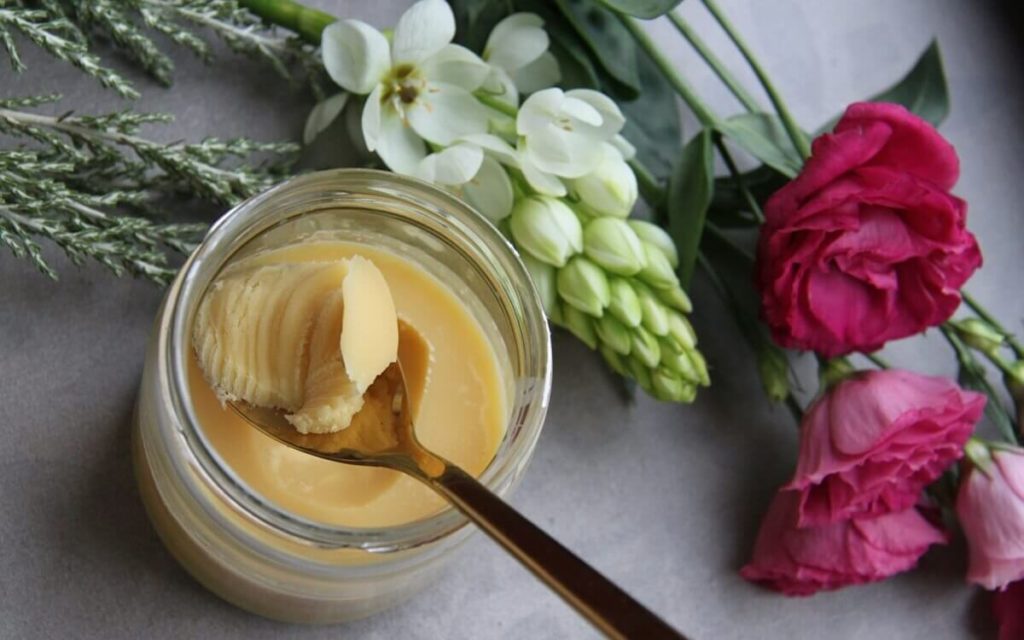
In addition to its health benefits, it is also used in cooking. It offers the following three advantages:
- High smoke point: While liquid butter or other oils burn protein when heated intensely, this does not happen with hot Ghee. Even at temperatures well above 100 degrees Celsius, the fatty acids remain intact and do not oxidize. This prevents the formation of free radicals, which are generally considered unhealthy.
- Long shelf life: While butter eventually turns rancid, Ghee can be stored for weeks, even without refrigeration.
- Suitable for lactose intolerance: The lactose content in Ghee is so low that it can be safely consumed by people with lactose intolerance.
Effects and Application Methods
In Ayurveda, clarified butter is highly valued, and for good reason! This golden-yellow fat can be wonderfully used for various purposes, be it for cooking, as a medicinal measure, or for Ayurvedic skincare.
Ghee as Clarified Butter for Cooking
Unlike other fats, you can heat it to high temperatures without issues. This makes Ghee so suitable for cooking.

The fatty acids remain stable up to temperatures of 180 °C, allowing you to sear meat, fish, or vegetables. No dangerous trans fatty acids (e.g., acrylamide) are formed, which can, among other things, trigger cardiovascular diseases.
In addition, it is easily digestible and gives your food a pleasant, mild buttery flavor. This is precisely why clarified butter is also excellent for baking.
But how healthy is Ghee? Clarified butter is still pure fat, so you should not overdo it—just as Ayurvedic teachings prescribe for every area of life.

“In Ayurveda, Ghee is far more than a traditional fat. Its special quality lies in ideally combining enjoyment, digestibility, and Ayurvedic effects.”
Deepa Naik, Ayurveda Specialist at the European Ayurveda Resort Sonnhof in Tyrol
Ghee’s Effect on Gut and Internal Health
When you cook with Ghee, your digestive fire, or Agni, will particularly benefit. It is promoted by Ayurvedic clarified butter, and it also helps, for example, in the regeneration of the stomach after gastrointestinal inflammation. It is also used for Ayurvedic colon cleansing and detoxification.
Ghee can also help with bone and joint health, as well as with related conditions and inflammations. (4)
In the morning, you can try oil pulling. Take some Ghee in your mouth and swish it through your teeth for 20 minutes. It is very important that you spit it out immediately afterward and brush your teeth with a separate toothbrush.

This is because the fat extracts toxins from your mouth and throat, which you should logically not swallow again. Oil pulling helps prevent cavities and inflammation. In Ayurvedic hygiene, the use of mouth care oil is particularly recommended.
Overall, clarified butter has a purifying effect and detoxifies the body by binding and eliminating toxins. There is even medicinal Ghee: this involves mixing butter with Ayurvedic medicinal herbs and simmering it for up to 4 days. This is said to allow the herbs to act even more intensely. It is also said that it can even lower cholesterol levels.
Ghee in External Application
Whether internal or external inflammation: Ghee can achieve a lot. The anti-inflammatory effect of clarified butter helps, for example, to prevent scars and blistering or to reduce redness. For psoriasis, you can also use clarified butter for care.
It can also be used in your regular skincare routine; for instance, the fat is good for removing makeup in the evening. Ghee has a soothing effect on the skin, which you can utilize in many situations.
And for a little wellness before bed, Ghee or a massage oil can be used. Massage your foot soles with the oil and treat yourself to a Padabhyanga self-massage. This is said to promote better sleep.
By the way: Ghee can help with dry eyes (1). Simply warm 2-3 tablespoons of it in a water bath and use a thermometer to ensure the temperature does not exceed 33 °C. Bathe your eyes twice a week for 10 minutes each time in the liquid Ghee, and the annoying itching and scratching should soon be a thing of the past.
Ghee: Health Benefits and Use in Ayurveda Cures
The Ayurvedic cleansing therapy Panchakarma proceeds in two phases: first, a preparatory treatment, followed by the main treatment. During the preparatory treatment, slags and toxins are released—the agent for this is clarified butter, Ghee. After this preparatory treatment, initial complaints may subside, and lightness and joy of life return.
This shows that Ghee indeed achieves effects because it binds toxins, allowing the body to successfully eliminate them. This benefits the digestive tract, as it has a regenerating effect, especially in the stomach, and can promote digestion.
Where Can I Get Ghee Clarified Butter?
Have you become curious and want to try Ghee for yourself? Then you have two options: You can buy it or simply make it yourself.
Where Can I Buy Ghee?
Producing high-quality Ghee takes time. If your schedule is already full or you don’t quite dare to tackle the production process yet, you can quickly and easily buy the finished product in many health food stores. You can also get our Original Ayurveda Ghee from certified organic farming from us.
Make Your Own: The Recipe
Conveniently, it’s not that difficult to make Ghee yourself. The most important ingredient: patience! You should definitely allow at least an hour for the preparation and not let yourself be distracted during this time.
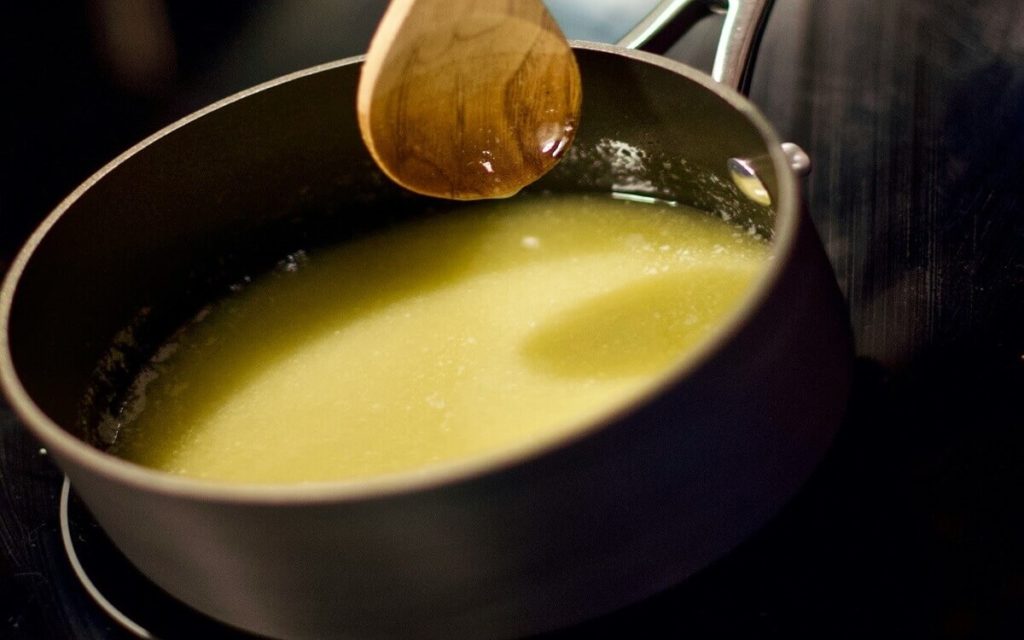
To make Ghee, you will need:
- Organic pasture butter / sweet cream butter
- A wide pot, ideally made of stainless steel
- A sterile canning jar with a swing-top lid or a screw-top jar
- A cotton cloth or, alternatively, coffee filters
When making Ghee, simply follow these step-by-step instructions, and everything will work:
(1) Cut the butter into pieces and place them in the pot. It is important that when liquid, it is not too high in the pot.
(2) Let the butter melt over low heat without browning.
(3) Briefly increase the heat until the butter boils.
(4) Reduce the heat again and let the butter simmer for about 30-40 minutes. Depending on the amount of butter, it may take longer—patience is key here, don’t rush anything!
(5) Skim off the protein foam that forms on the surface repeatedly. The Ghee is ready when no more foam forms and the fat has a clear color.
(6) Remove the pot from the stove and then you should let it cool for a few seconds. Meanwhile, place the cotton cloth over the opening of your canning jar.
(7) Pour the Ghee through the cloth into the jar. Alternatively, a coffee filter can be used for straining.
(8) Seal the jar tightly. If you have a screw-top jar, you can briefly turn it upside down. This creates a vacuum, which makes the clarified butter last even longer.
You do not need to store the finished Ghee in the refrigerator, but you should avoid direct sunlight. Be sure to stay at the stove the entire time while the fat is simmering so you can remove the pot immediately if something burns. Do not stir the butter during this process.
As you can see, making Ghee yourself is not magic. You might need one or two attempts until you are completely satisfied with the result, but practice makes perfect, as they say.
And then all that’s left is to try out all the positive effects on your own body—you certainly won’t regret it!
Clarified Butter: What Can It Be Used For in Cooking?
Whenever a recipe calls for frying, roasting, or baking, you can use Ghee instead of various oils or butter. Just try it out to see if and when you enjoy using it.
Ghee is also used in Ayurvedic breakfast and can be well integrated. Simply stir a tablespoon into oatmeal; this can provide Vata types with an energy-rich start to the day.
For all those who enjoy a light breakfast with fruit: it can be pan-fried, making it easier to digest. Good luck!

Ayurvedic Detoxification: Methods & Home Remedies for Ayurveda Detox
Ayurveda detoxification, cleansing, detox cure—whatever you call it, everyone benefits from an occasional cleansing of the liver and kidneys. In our article, you will learn how you can perform a small cleansing cure from home and which home remedies can help.
Cover image: © Ivannag82 – istockphoto.com (File No.: 1316599821)
Sources:
(1) Horwarth-Winter, J. et al. (2008): Butterschmalz bei trockenen Augen. KlinOptikum 12. URL: https://www.uniklinikumgraz.at/fileadmin/media/lkh-univ-klinikum-graz/Uniklinikum/ueber_uns/Klinoptikum/Klinoptikum-04-2008.pdf
(2) Sedgi, F. et al. (2024): The effects of replacing ghee with rapeseed oil on liver steatosis and enzymes, lipid profile, insulin resistance and anthropometric measurements in patients with non-alcoholic fatty liver disease: a randomised controlled clinical trial. British Journal of Nutrition, 131(12), 1985–1996. doi:10.1017/S0007114524000564.
(3) Kumar, A. et al. (2018): Ghee : Its Properties, Importance and Health Benefits. Lipid Universe, 6, URL: https://www.researchgate.net/profile/Anil-Kumar-233/publication/339499398_Ghee_Its_Properties_Importance_and_Health_Benefits/links/5e562e67299bf1bdb83b26d3/Ghee-Its-Properties-Importance-and-Health-Benefits.pdf.
(4) Falahatzadeh, M. et al. (2024): From tradition to science: Possible mechanisms of ghee in supporting bone and joint health. Prostaglandins & Other Lipid Mediators, 175. doi: https://doi.org/10.1016/j.prostaglandins.2024.106902.
(5) Kataria, D. & Singh, G. (2024): Health benefits of ghee: Review of Ayurveda and modern science perspectives. Journal of Ayurveda and Integrative Medicine, 15 (1), doi: https://doi.org/10.1016/j.jaim.2023.100819.